Currently, the page lists the Titans as having about $86.5 million in contractual commitments. This is actually less than the total current salary reported by Paul Kuharsky of approximately $92 million, with the difference between the futures contracts which I do not bother to fill in. Those players are for the most part quite unlikely to make the roster this season.
As I note in the introduction to the current version of the page, the precise numbers should be treated as estimates only. Some of the estimates are quite good, while others are estimates or interpolations based on good data. In addition to the major errors and known unknowns, there is missing data small and probably large as well. For instance, it's unlikely Chris Johnson is the only player whose compensation is subject to workout-related adjustment, but he's the only one for which I've seen information showing he is. It's also unlikely that there are no players whose 2012 compensation has performance-related adjustments, but I don't have that information either.
I'll be adding pages for future years going forward, but this is at least a start. Corrections, comments, questions, and the like are welcome. no comments
I consider the Texans o-line to be the best in the league (among the lines I have seen several times) and I agree with Wycheck's observation. Although I considered him to be more of a H-back than an inline blocker, I respect his knowledge of offensive line play and his thoughts carry a great deal of weight with me.
The Titans o-line was coached and trained by a Hall of Fame lineman and they're now coached by another HoFer. Why is it that two Hall of Famers are being out-schemed by John Benton, the Texans' line coach?
no comments
2011 was a year of change for the Titans at the quarterback position. For five years, Vince Young and Kerry Collins alternatingly provided somewhat different definitions of what it meant to be the starting quarterback for the Tennessee Titans, but for better and worse that was the situation.
For being a year of transition, though, the recently-concluded regular season saw surprising stability, as for only the second time since they became the Titans, for better or for worse, the starting quarterback was the same for all sixteen games. 2012 should provide no such overwhelming transition, as the Titans return both that starter and every quarterback who took a regular season snap, but that doesn't mean it couldn't and shouldn't be a year of change nonetheless.
no comments
Most underachieving player, offense: Chris Johnson
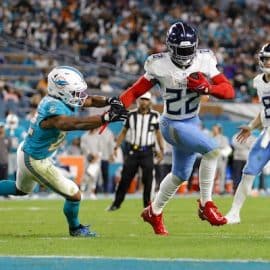
For a guy who claimed he was a playmaker and deserved to be paid like one, Chris Johnson didn't achieve like a playmaker, barely gaining 1,000 yards in 2011. CJ was tied with Beanie Wells for 14th in the league in rushing, 559 yards behind Maurice Jones-Drew. He would have been worse than a tie for 14th, if not for season-ending injuries to Matt Forte, Adrian Peterson and Fred Jackson. CJ had more games with less than 25 yards (five) than games with over 100 yards (four) last year. CJ's stinkers were games of 9 carries for 24 yards (Jaguars), 13 for 21 (Broncos), 10 for 18 (Texans), 12 for 13 (Falcons) and 11 for 23 (Saints.) I remember when rushing for 1,000 yards was an accomplishment. Now it’s mediocre, which is about all CJ was last year. Here’s another interesting stat: CJ’s 4.00 yards per attempt was 49th best among backs with 50 or more carries last year.
no comments
Before the Titans signed Washington as a free agent before the 2009 season, Nate had been the Steelers' number three receiver behind a couple pretty good wideouts in Hines Ward and Santonio Holmes. As you might expect, Washington had not been a particularly high-volume receiver and had never put up big numbers, with career highs of 40 catches and 631 yards, both in 2008. With the Titans, Washington was thrust into the unfamiliar starters' role, but his numbers the first two seasons with the team (47-569, 42-687) were pretty similar to what he'd done in Pittsburgh. In the Titans' run-heavy attack, he had only slightly more passes thrown his direction, but his catch rate was pretty low and advanced statistics weren't much kinder to him.
That all changed in 2011, though. Chris Palmer came in with his much more advanced passing game, in terms of routes and reading, and as you'd hope from a veteran receiver, Washington caught on to the scheme pretty quickly, emerging almost immediately as a valuable second option taking advantage of the attention teams paid to Kenny Britt. He was most effective working in the slot, often against a safety, third cornerback, or even a linebacker in zone.
Then, of course, Britt went down, lost for the year, and life got a whole lot harder for both Washington and the Titans' passing attack as a whole. He had to shoulder the role of the Titans' top receiver, and without much consistent help. It was a difficult role for him, and the results (and numbers) weren't always what I'm sure he and the Titans wanted. When I wrote late in the season about how the Titans' base offense some games simply didn't work, Nate Washington as their top wideout was part of that.
Nevertheless, Washington did his best to shoulder the burden, put in the work to learn the offense and get on the same page. He ended up as the key target for both Matt Hasselbeck and Jake Locker, who looked to him early, often, and with regularity, and blew away his career highs with 74 catches for 1,023 yards, while also putting up his best efficiency numbers with the Titans, much better ones than his fellow non-Britt wideouts.
Honorable Mention: That aforementioned defensive rookie class, four members of which (OLB Akeem Ayers, DT Jurrell Casey, MLB Colin McCarthy, and DT Karl Klug) saw extensive action without looking out of place. no comments
- General Manager Mike Reinfeldt was promoted to Senior Executive Vice President/Chief Operating Officer;
- Vice President of Player Personnel Ruston Webster was promoted to Reinfeldt's Executive Vice President/General Manager job; and
- Vice President of Football Operations Lake Dawson was promoted to Webster's Vice President of Player Personnel job.
The moves fill the void created by last year's retirement of Steve Underwood and put people in jobs for which they are probably better suited. Reinfeldt was always more of an operations and financial guy as general manager, Webster undoubtedly provided a key voice in personnel acquisitions since joining the Titans in 2010, and Dawson had been Director of Pro Scouting for four seasons before spending last year in the VP/Football Operations job.
Beyond getting new business cards and probably more money, it's not necessarily clear how much Reinfeldt, Webster, and Dawson's day-to-day job responsibilities will change. The moves fill the organizational chart, and are probably strong enticements to Webster and Dawson to stay in Tennessee. Both men have been mentioned in connection with the Rams general manager job, and I assume today's announcement means both men are staying in Tennessee.
There was no announcement of who, if anybody, will fill Dawson's former Vice President of Football Operations job. It was also reported today defensive coordinator Jerry Gray has been granted permission to interview for the Indianapolis Colts' head coaching job, which I will only write more about if Gray takes a head coaching job.
no commentsI have particularly insightful to say about Maxie, and only vaguely remember his existence as a safety for the Saints, Panthers, and other teams during a 12-year NFL career. Maxie previously served as a secondary coach with the 49ers, Falcons, and Dolphins before spending the past four years with the Cowboys, and this will be his first time receiving an NFL paycheck from Bud Adams.
In taking the job, Maxie replaces the departed Marcus Robertson, who had been one of the holdovers from the Jeff Fisher era. I have no strong feelings one way or the other on Robertson's firing, beyond noting that with a deeply truncated offseason and a secondary returning its top five players it made perfect sense to retain Robertson for the 2011 season unless he was actively bad. I saw no indication he was, but am interested to see the Titans bring in a position coach with a lot of experience around the league. no comments
Let's start with a couple first-level measures. The Titans gave up 4244 passing yards in 2010, and only 3809 in 2011. That's not bad, especially when NFL teams as a whole gave up 123 yards more. Of course, the Titans also faced more passing attempts in 2010 than they did in 2011, 625 compared to 591. In Yards Per Attempt numbers, the Titans' defense improved from 6.79 YPA to 6.45 YPA.
Of course, not every called passing play results in a passing attempt, as sacks also play a role. As we know, the 2011 Titans weren't as good at getting to the passer as the 2010 version. The 2011 Titans had 28 sacks for a loss of 180 yards, whereas 2010 saw 36 sacks for 212 yards. With those sacks added in, the 2010 Titans gave up 4032 yards on 661 plays, whereas this year saw 3629 yards on 619 plays. In Net Yards Per Attempt numbers, the Titans' defense improved from 6.10 NYPA to 5.86 NYPA.
Then again, pure yards numbers ignore that passing attempts sometimes result in particularly valuable plays for either the offense or the defense, namely yards or interceptions. We'll instead get to my favorite measure, adjusted net yards per attempt. To make the adjusted net yards per attempt calculation, add 20 yards for every passing touchdown allowed and subtract 45 yards for every interception. The 2010 Titans allowed 23 passing touchdowns and had 17 interceptions. In 2011, the Titans allowed 21 passing touchdowns and only picked off 11 passing. In Adjusted Net Yards Per Attempt, the Titans' defense went from 5.64 ANYPA to ... 5.74 ANYPA. The pass defense actually ... got worse?
no comments
At first blush, giving a tight end with 21 receptions in four seasons a contract averaging close to $4 million a year seems like an extravagance, but Stevens was much more important to the Titans than his nine receptions for 166 yards this year would indicate. His receiving numbers are much more a product of the existence of Jared Cook, whose presence largely indicated the Titans were going to pass the ball, and when they did throw the ball to Stevens, it generally ended up working out pretty well. While Cook's continued presence probably means Stevens will not be a valuable fantasy option, they could probably throw to him an average of more than once a game. Stevens is also the Titans' only complete tight end, and perhaps the single best run-blocker the Titans have.
The one cautionary note I'd add is Stevens does have a bit of an injury history. He's missed one game each of the past two seasons, with rib and knee injuries respectively, and missed four games in 2009 with a couple concussions. The Titans are probably willing to live with the former, but the latter always scares me. Still, I'll be happy to see Stevens back in a Titans uniform this year, and even happier him sticking around means less of Jared Cook trying to block and Daniel Graham as a pass-catcher. no comments
Casey, a third-round pick out of Southern California, didn't quite have the splash of Karl Klug, who led the team in sacks with 7.0, but was an immediate impact player, starting from day one, and ended up as the Titans' most consistent and consistently productive defensive lineman. He was involved in almost 50% more plays than any other defensive lineman.
In fact, by Football Outsiders numbers, he had more successful tackles on run plays than any other member of the Titans, and had almost as many successful plays in total as any other member of the Titans defense. To put that in comparison, last year Stephen Tulloch had more than twice as many successful plays as any defensive lineman. Many times when a player was involved in a play, it's because he was getting beat or making plays downfield. By contrast, Casey's rate stats were as good or better than any defensive lineman on this year's Titans team or last years. While he had 2.5. sacks and one forced fumble, he wasn't quite enough of a disruptive force to declare Dave Razzano was right when he declared Casey would end up looking like a top-seven pick, but he still had a fine rookie year regardless.
no comments